Athletes are paid for performance and valued for attention. The value of a famous name is built mostly outside the arena, outlives the career, and belongs to no one who is paid to grow it.
Star names already trade as assets: Authentic Brands Group paid about $270 million for 55% of David Beckham's brand in 2022. But they are priced only once fame is mature and the person is no longer an athlete. Nothing exists to own, price or build the asset early.
First Light does that. It finds athletes with latent star potential, takes an equity stake that grows as value is delivered, and builds the real-world contexts that turn a rising athlete into a star. MMA is the beachhead market, because of personality-heavy promotion tailwinds, and a decade of promotion policy that has pushed every source of a fighter's upside outside the cage. Individual sports come next.
The claim: the name is the asset
A successful athlete doesn't make money from the sport, they make a name from it, and then make money off that name. The sport is just one of the platforms where the athlete's name gets made, but much of the asset value is created off the field. That name asset is what makes real money, outside of the sport, for longer, and nobody owns that process.
The name outlives the career
Michael Jordan earned roughly $90 million in NBA salary over his career. His Nike royalties alone are reported around $300 million a year, more than two decades after his last game. The salary paid for the performance. The royalties pay for the name.
The pattern repeats across sports. Muhammad Ali's name is still licensed decades after his death. David Beckham's brand was valued at about half a billion dollars, years after he stopped playing. Tiger Woods launched an apparel brand with TaylorMade in his late forties. Conor McGregor's whiskey brand sold for a reported $600 million, built on a fight record shorter than most champions'.
A playing career lasts five to fifteen years. It is the creation phase. The name is the durable asset that the career produces.
Sport is a market for attention
Strip sport down to its economics and it is a business of capturing attention and selling it to brands. FIFA is a clean example. In its 2019–2022 cycle, broadcast and marketing rights made up roughly 69% of its $7.57 billion in revenue. Divided across its reported cumulative audience, that is roughly one dollar of rights revenue per viewer.
The chain does not stop there. A sponsor spends roughly another $0.81 activating every dollar of rights it buys. To make that back at the return on ad spend consumer brands require, it needs each viewer to spend several dollars more on its products. Every layer of the chain is paying for the same thing: someone's attention, with intent to buy.
Every actor in sport has a role in that market. The athlete captures attention. The promotion or league packages it. The broadcaster brokers it to advertisers and subscribers. Seen this way, an athlete is an entertainment asset like any other, one that has outsourced the brokerage of its own attention to the league and the broadcaster.
The athlete is a media company that has never been run as one
Take that frame seriously and the athlete looks like a media company. It has a few tentpole content events a year (roughly two, for a fighter). It rents its audience from platforms it doesn't control: the broadcaster, the promotion, the federation, the social networks. And it has a revenue line that has never once been optimized.
The obvious question follows. What does that media company do in the fifty weeks a year when the athlete isn't competing?
Skill and fame are correlated, but loosely
The best athletes are not always the most famous ones. The correlation between skill and commercial value is real, but far from absolute. Playing style, language, media availability, personality, lifestyle, timing, storyline, all move an athlete's fame independently of their results. Star value can be built far beyond what results alone would produce, and every athlete well above the curve shows how far. (Exhibit 1)
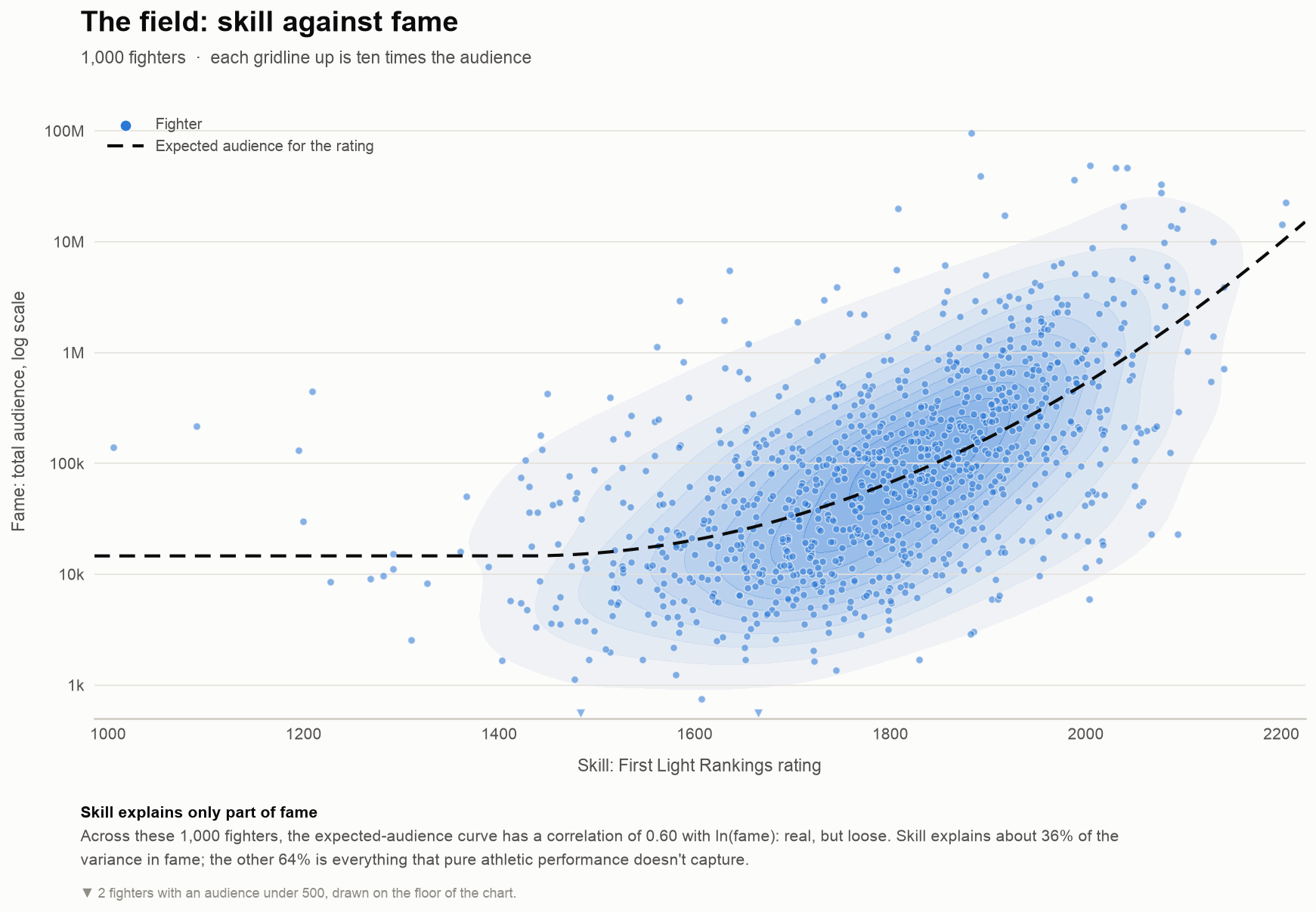
Exhibit 1: the fame-vs-skill scatter applied to MMA.
Nobody is paid to build the long-term asset
The gap persists because of how the industry is structured, not because it is invisible. Most athlete managers are booking agents. They take 10–20% of the current contract, so they optimize this year's salary. Promotions and leagues own the event, not the person. Brands rent the athlete for a campaign.
No one in the chain (even the athlete) holds real equity in the name, so no one is paid to compound it. That is why the asset is underbuilt, and why it is unpriced.
What an asset class needs
An asset becomes an asset class when three things exist: a pricing signal, a standard instrument, and a lever that creates value. Star IP has pieces of each, scattered across a few companies. None has all three at the early stage, which is where most of the value is created.
The three components
A pricing signal answers what an asset is worth today and what it could be worth. A standard instrument answers how you own a piece of it. A value-creation lever answers who makes it grow and how.
Venture capital is the clearest precedent. It needed comparable valuations to price startups, standard securities to own them, and investors who operate alongside founders. Its growth also owed something to standardized, open terms. Y Combinator's SAFE, published in 2013, gave seed investing a common contract that anyone could use without negotiating from scratch.
Star IP has no equivalent. First Light will publish its deal terms openly, as a standard others can adopt. A market grows faster when the instrument is common knowledge, and whoever writes the standard sits at the center of it.
Negotiation without prices
Today an athlete negotiates a few times in their career against a counterparty that negotiates hundreds of times a year and knows every comparable. That asymmetry does not just shift value to the informed side; it suppresses the total price the asset can reach.
When prices become visible, the informed side loses its edge, and the floor rises for the side that was underpaid. But a price is only one part of what a market needs. Markets tend to fail not because an opportunity has no value, but because the institutions needed to evaluate, price, and finance it haven't developed yet.
Sports franchises are the clearest case. For decades, stakes in major league teams were closed to institutional capital, even as franchise values kept compounding. Then the leagues opened the door: MLB began allowing institutional funds to buy minority stakes in 2019, the NBA in 2021 and the NFL in 2024. Specialist firms like Arctos Partners built businesses on it, and team stakes became an asset class investors could price and own. The value had always been there; the institutions to evaluate and finance it had not.
This is why First Light publishes. The Index publishes rate bands and valuations so that both athletes and brands can see what a name is and could be worth.
The four axes
Every company that touches an athlete's star value can be placed on four axes:
- Asset maturity: does it enter early, before fame is built, or buy mature fame that is already proven to outlast the sport?
- Source of value: does it bet on in-sport earnings (contracts, salaries, purses) or out-of-sport value (brand, ventures, media)?
- Structure: does it own equity in the asset, or take a commission or retainer?
- Role: is it a hands-on operator that builds value, or a speculator that bets on outcomes?
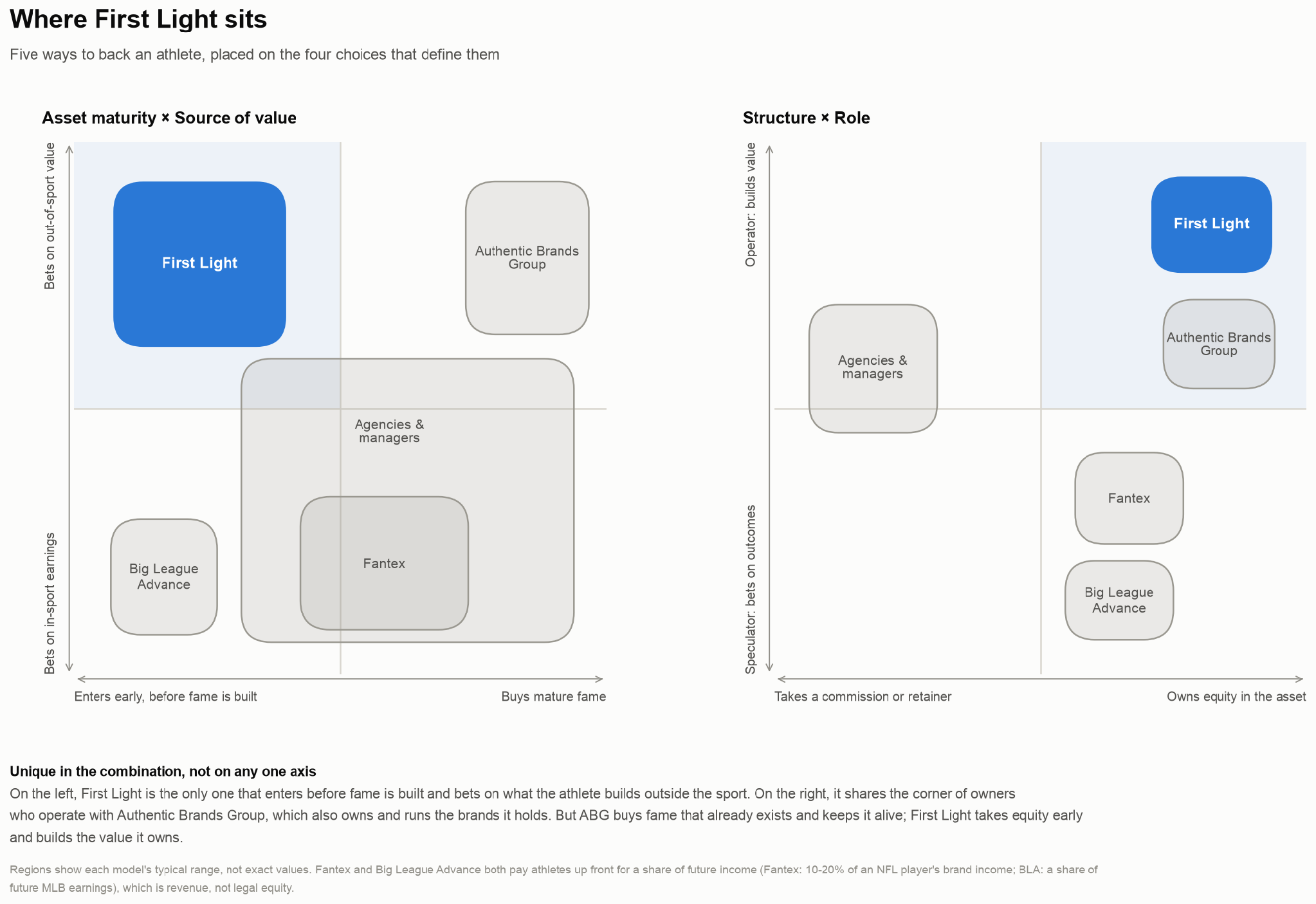
Exhibit 2: market positioning of First Light and incumbents.
Authentic Brands Group: the closest thing, at the opposite end of the lifecycle
ABG is the company most like what First Light is building, so it is worth explaining properly. Founded in 2010, it owns intellectual property and licenses it to operating partners who manufacture, distribute and sell. It collects royalties without running factories or stores. Its portfolio mixes consumer brands like Reebok and Brooks Brothers with famous names: Marilyn Monroe, Elvis Presley, Muhammad Ali, Shaquille O'Neal.
In 2022 it bought 55% of David Beckham's brand company for about $270 million, valuing the brand at roughly half a billion dollars. That deal proves the asset class exists. A living athlete's name was priced, bought as equity, and run by an operator.
It also shows how narrow the class is. ABG buys names that are already famous. On the four axes it matches First Light on source of value and structure, and is close on role. It is opposite on maturity. ABG buys the finished building; First Light finances and builds it. Companies like ABG are also a natural eventual buyer of the names First Light builds.
Fantex: speculative and in-sport
Fantex, launched in 2013, sold tracking stocks tied to individual NFL players' future income, starting with players like Vernon Davis. It bought into active players at different career stages, from recent draft picks to established Pro Bowlers: later than First Light, earlier than ABG. Its stakes were equity-like, which matches First Light on structure. It was opposite on the other two axes. Its returns depended mostly on playing contracts, and it added nothing to the players' value beside the capital invested. Investors bought a ticket on a career they could neither price nor influence. As far as public records show, it never found a durable market and wound down.
Big League Advance: early, but passive and in-sport
Big League Advance pays minor league baseball players cash up front for a share of their future MLB earnings. It is early, but it bets on in-sport outcomes and does nothing to change them. It also faces adverse selection: the players with the best prospects are the least likely to need the money.
Talent agencies and managers: operators without equity
Agencies like CAA and WME, and sport managers at a smaller scale, are operators to the extent that they negotiate the price of talent, but without doing anything to raise its value. They are paid on commission, so their incentive ends with the current deal. Their structure is what leaves the long-term asset unbuilt.
The empty quadrant
Early-stage, out-of-sport, equity, operator: no one is there. The asset class exists at maturity and in speculative forms. At the early, operator-built stage, there is no structure at all.
The lever: how star value is created
Stardom is not an innate X factor. It is the result of a social process that can be understood, started and steered. This value-add claim is what the whole model rests on.
Rosen: stars earn more than their talent gap explains
In "The Economics of Superstars" (1981), Sherwin Rosen explained why small differences in talent produce enormous differences in income. A performer can serve millions at once through broadcast, and audiences won't accept ten mediocre performers as a substitute for one great one. So the top of any field captures a disproportionate share of the market.
Rosen called the input "talent". In sport, that word hides a confusion. The talent the market pays for is not athletic ability; it is entertainment value. The two are correlated, which is why they are easy to conflate, but the arbitrage lies in the space between them.
Tennis offers a clean example. Anna Kournikova never won a WTA singles title, yet for years she was among the highest-paid women in sport. The market was not mispricing her tennis; it was pricing something else.
Adler: stars can emerge without a talent gap at all
In "Stardom and Talent" (1985), Moshe Adler went further. Entertainment is consumed socially. People enjoy a performer more when they know more about them, and they learn more by talking with others who follow the same performer. So consumers gravitate toward whoever others already follow.
That creates a feedback loop. An artist becomes somewhat popular, more people consume them, people learn more about them, consumption becomes more enjoyable, and even more people consume them. The phenomenon is reinforced by media machines that show what will bring attention, and in turn amplify it. Superstar inequality can emerge from this loop alone, even between performers of equal talent. Extreme success is not reliable evidence of extreme talent.
Sport is a cultural good of exactly this kind. You choose to follow what others follow so you can enjoy it with them, in person and online.
The flywheel: start it, and the industry carries it
Adler's loop means fame compounds from a small, partly arbitrary start. That shapes the economics of the lever. First Light does not need to outspend the league, the broadcaster or the media to create a star. It needs to start the loop early, and give each of them a reason to join.
Once an athlete starts drawing attention, everyone else amplifies it for their own reasons. Fans talk about whoever others are talking about. Media outlets and creators cover the name that is already moving, because it brings them audience. The UFC pushes the fighters who bring viewers, because that is what Paramount pays for. Each actor's self-interest pushes the same name further.
So First Light's model runs on tailwinds, not headwinds. The leagues want stars; they simply don't invest heavily in creating them. First Light supplies the early push the promotion won't, and the industry's machinery does most of the rest. The cost of starting the loop is small next to the value it compounds into.
The loop is also path-dependent. Timing and luck matter, and not every push catches the first time. The work is to keep creating moments for each athlete until the loop takes hold, not to passively wait for one of them to explode. That is why First Light runs a portfolio: a focused set of athletes, each built individually, not a single bet and not a spreadsheet of thousands.
What brands want, and what they are sold
Brands do not want followers. They want attention with purchase intent, inside a demographic they can convert. Sponsorship should be priced like advertising: cost per thousand impressions, adjusted for audience quality, geography, purchasing power and likelihood to buy.
What they are mostly sold is follower counts, because that is the number the market can see. An athlete with 900,000 passive followers spread across a country with low purchasing power is worth less to a US supplement brand than an athlete with 150,000 engaged followers who are American men aged 25 to 40. On follower count alone, the first looks six times more valuable.
Followers from fame are not fame from followers
A follower who arrives because someone became famous in the real world is not the same as a follower acquired by gaming an algorithm. The first converts: they buy tickets, products and subscriptions. The second often doesn't.
The online sponsorship market is currently drifting toward the second kind. Agencies sell placements on accounts with inflated audiences, weak engagement and no purchase intent, and brands still buy on outdated metrics that are easy to game. Taken to its extreme, everyone has the numbers to look famous and no one is actually known. An advertising market cannot run on that. My bet is that the market will correct, and that real-world stardom with measurable influence will become the only thing that commands a premium again.
Manufacturing a star means building contexts
The lever is not algorithm hacking, engagement-baiting, or better hooks on posted videos. Making a star means actually making them interesting. It means building the real-world contexts in which an athlete matters: rivalries with stakes, narratives that make people care about an outcome, platforms to showcase personality, events, access, being in the right rooms. Social numbers follow as a consequence.
Industrialized star-making has existed for a century:
- The Hollywood studio system put actors under long contracts and built their personas deliberately, down to their names.
- K-pop agencies select, train, launch, and manage performers, owning much of the resulting value.
- WWE treats narrative as the product. It produced Dwayne Johnson, whose name eventually became far bigger than the platform that made it.
- Drive to Survive made Formula 1 drivers marketable in the United States and exploded female audiences, without changing a single result on track. The cars didn't change; the context did.
Jake Paul is the instructive complication. He started with online fame, but the value was created when he converted it into real-world events, culminating in a fight against Mike Tyson streamed on Netflix. Even there, the event did the work, not the feed.
Media products as a revenue line
If the lever is context, then the contexts themselves are products. Documentaries, series, recurring formats and events built around athletes have their own buyers: streamers, broadcasters, brands. Drive to Survive is a product Netflix pays for, not just a marketing tool for F1.
That makes media production more than a cost of building a star. It is a revenue line in its own right, and the first step toward owning the media layer outright (Section 6).
Tripwire: if athletes whose fame is built through real-world contexts don't command measurably better commercial terms than athletes who grow through organic social media alone, the lever is weaker than claimed.
Every athlete is meant to become a star
Star value is unevenly distributed. One McGregor earns more outside the cage than a hundred mid-card careers combined. A business built on star value should aim to create stars, not to nudge above-averages.
That does not make First Light a bet on finding the one athlete who carries everyone else. Every athlete First Light works with is invested in to become a star: a name that earns at least seven figures a year outside the sport. An unprofitable athlete is a true failure, not an accepted cost of a power-law model. Some outliers will explode far above the rest, but the structure never depends on them to stay afloat.
Why MMA first, why now, why me
MMA is the sport where commercial value is least correlated with competitive success, and where the gap between an athlete's commercial potential and what they capture is widest. Over the last decade, every mechanism that paid a fighter for their own drawing power inside the promotion has been closed. The only uncapped upside left is outside the cage, and almost nobody is organized to build it.
The case works at two levels: first the industry, whose incentives have shifted; then the individual athlete, who is the asset.
The promotion owns the brand
The UFC takes its brand more seriously than any other combat sports organization. The Octagon is trademarked. The rankings are UFC-administered. The belts are UFC property, and "champion" is a company designation, unlike boxing's independent sanctioning bodies. Events are named "UFC 217", not "Bisping vs. St-Pierre". Fighters put "UFC" in their Instagram handles, not as an achievement but as a brand attachment.
The sport follows a rule from WWE's Vince McMahon that boxing never adopted: no fighter can be bigger than the promotion. That rule explains the policy changes below.
The Reebok deal: the end of independent sponsorship
In July 2015, the UFC began a six-year, $70 million exclusive outfitting deal with Reebok. All fighters and their corners had to wear standardized Reebok gear during fight week and inside the Octagon.
It was a necessary step in one sense. Before it, fighters negotiated their own sponsors and fought as walking billboards for companies like Condom Depot and Dude Wipes. The deal made the UFC look cleaner and moved it further from its early "human cockfighting" reputation.
For fighters it meant three losses:
- A promotion tool. Every fight now featured two athletes in nearly identical kits. The iconic looks of the past, like Mirko Cro Cop's checkered shorts or Tito Ortiz's flame trunks, disappeared. Custom shorts have since returned for top stars, but independent sponsors have not.
- A monetization tool. Fighters used to earn $20,000 to $50,000 per fight from sponsors. The Reebok payments were tiered strictly by tenure, often $2,500 to $5,000. More fights meant more pay, regardless of winning or drawing power. Rory MacDonald, Benson Henderson and Matt Mitrione all cited the deal as a reason they left the UFC. When it expired in 2021, the UFC signed a similar deal with Venum, and the ban on in-cage sponsors remains.
- A pricing tool. This is the loss nobody discusses. Individual sponsorship was the one market through which a fighter could demonstrate independent commercial value. A brand paying a specific fighter a negotiated price is a price signal on that name, and those prices were somewhat public and comparable. The deal didn't just capture value; it destroyed the instrument a fighter used to know, and prove, what they were worth.
The Paramount deal: the end of pay-per-view points
In January 2026, the UFC moved to a seven-year, $7.7 billion broadcast deal with Paramount, that ended the pay-per-view model in the United States. Fans used to pay $60 to $80 per event. Now events stream on Paramount+ at no extra cost, a far lower barrier for casual and mainstream audiences.
Pay-per-view points went with it. Headlining fighters used to earn a share of every pay-per-view sold, which gave them a direct reason to promote the events. Fighter purses are flat multi-fight contracts, outfitting pay is tiered by tenure, bonuses reward in-cage performance, PPV points were the single line item that paid a fighter for being famous, and they are gone.
The purported narrative was that stars would receive bumps tied to viewership milestones, but fighters do not see this as an equivalent. Ahead of the biggest fight of his career, on the UFC's White House card, Justin Gaethje said he would not earn "one dollar more" than he would have without the Paramount deal.
The incentive shift nobody has priced in
Follow the money. Paramount pays a flat $1.1 billion per year for an asset that acquires and retains subscribers. Its return depends entirely on how many people show up and stay. So Paramount profits directly from fighters being famous outside the cage, because that is what makes someone watch and subscribe.
Paramount has no direct stake in suppressing fighter pay, no stake in the UFC's control of the labor market, and no inherited loyalty to how the sport has always paid. The sport has been sold to a partner whose return depends on fighters being famous outside the cage.
That creates a situation where fighters both can and must promote themselves more than ever:
- They can, because Paramount puts them in front of a far more mainstream audience than pay-per-view did. Their screen time reaches more people, and their sponsorships address a larger market.
- They must, because the company no longer pays them for drawing power. It will amplify a fighter's own efforts, but it won't do the work for them.
From Reebok to Paramount, each change removed a way for a fighter to capture upside from their own drawing power inside the promotion. The last lever is outside the cage, and it is the only one the fighter owns outright. It also raises their value inside the sport.
Strip the romance away and a fighter owns none of the value they create. Much of that value is created in a context the fighter doesn't own. The promotion owns the footage and the image rights to the fighter's own likeness in it. The promotion also chooses the sponsor whose logo sits on the canvas they fight on. The broadcaster owns the channel, and the platforms own the audience. The fighter earns from all of it, but owns and controls none of it.
First Light exists to build what the fighter can own: a name, and the business around it, outside the cage.
The promotion invests less in building stars
The promotion's own incentives have shifted as well. The UFC is owned by TKO, a public company controlled by Endeavor, which the private equity firm Silver Lake took private in 2025.
The Paramount deal changed the promotion's economics in three ways:
- Revenue is locked. The deal is worth about $1.1 billion a year, roughly 73% of the UFC's approximately $1.5 billion in 2025 revenue. When most revenue no longer depends on event-by-event demand, the return on investing in expensive stars falls.
- Buying psychology changed. A pay-per-view was an expensive decision made per event. A subscription is cheap and auto-renews. The fan no longer has to decide to buy; they have to not decide to stop. The bar for keeping a customer paying is lower.
- Fighters became a cost line. With broadcast revenue flat and predictable, expensive fighters stop looking like revenue drivers and start looking like costs. On a recent earnings call, TKO president Mark Shapiro told investors the company could "level-set athlete pay without diluting margins".
The UFC is shifting from selling the people and stories around a fight, to selling the violence and action of the fight itself. The product was built around anticipation: recognizable stars, rivalries, personalities, promotional narratives, and meaningful stakes. The emerging product is built more around spectacle: impressive finishes, dominant performances, knockouts, submissions, and immediate visceral entertainment. Matchups increasingly favor the possibility of decisive, one-sided action rather than competitive uncertainty between evenly matched opponents. The individual fighter's identity, the pre-fight narratives, and the competitive stakes matter less than what happens when the cage door closes.
Fans have noticed a change in the product. Build-ups are thinner, and face-offs, large press conferences and pre-fight interactions between fighters appear less often. Top fighters appear less, and they have noticed the shift too. Asked why the UFC rarely matches veterans against each other, Bobby Green explained it in business terms: each new contract pays a veteran more, so the promotion brings up new fighters to take their place. "It's just business." (Exhibit 3)
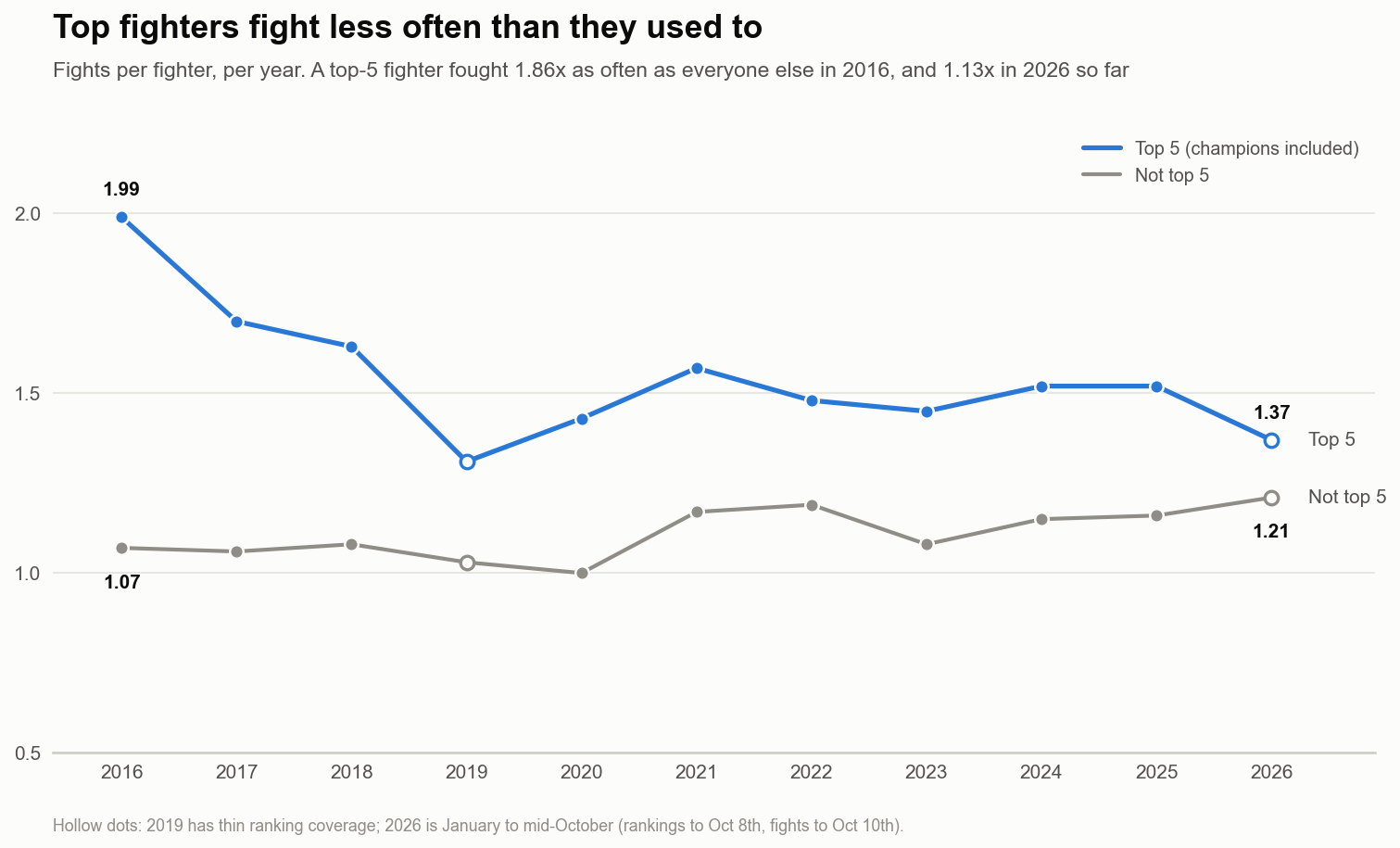
Exhibit 3: 10-year activity differential between top-5 fighters and the rest of the roster.
The flip side is that the fans notice an increase in the fight quality: fight action is much more entertaining, and finish rates are higher, likely by design as a consequence of more lopsided matchups. (Exhibit 4)
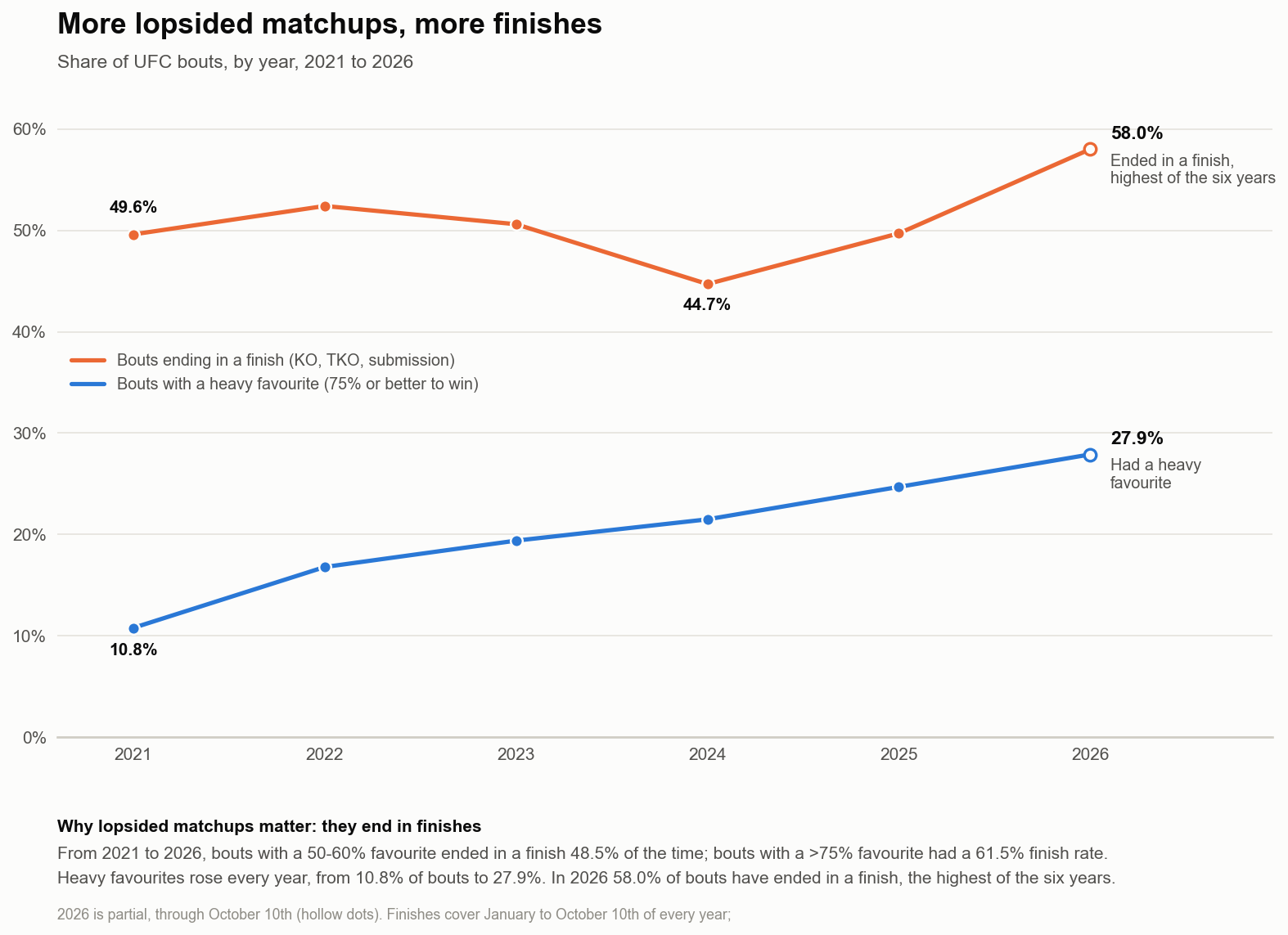
Exhibit 4: 5-year increase in lopsided matchups and finish rates.
UFC 332 is the strongest example. It was a numbered (big) event that was heavily criticized in the build-up as the worst card in history for having only four out of twenty-eight fighters who were top-15 ranked. It then broke the record of most KO/TKO finishes in history with eleven out of fourteen, and was called a very entertaining card overall.
The rest of the UFC's revenue does not depend much on stars either. Ticketing runs on a world-tour model: most cities host once a year, so each event is a scarce occasion that sells regardless of the matchups. Host-city incentive packages come from governments buying an event; New South Wales reportedly paid AUD $16 million (USD $10.58M) to bring the UFC to Sydney for three events. Owning its own arena, the Meta Apex, lets the UFC run cheap broadcast-only events and play hard-to-get with cities.
The Paramount deal has also brought in more ad inventory that competes with the fighters for airtime. Before, every main-card winner (even some losers) used to get a post-fight interview, where a lot of the attention is gained and money is made. Today, not every winner gets the microphone anymore, and there are fewer opportunities to self-promote. Expect an even thinner tail of outlier stars.
Stars are still what the market wants
None of this means the UFC doesn't want stars. It promotes the fighters who draw, and it pays the ones who bring in the numbers during their prime. What has changed is how much it will invest to create stars, and how long it will keep paying them once they decline.
The rest of the market wants them just as much. Every new combat league uses MMA stars to draw attention to its events: grappling and wrestling leagues, bare-knuckle boxing, influencer events. Demand for recognizable fighters is high. The promotion is simply investing less in making them. That widening gap, between what a star is worth and what the promotion will spend to make one, is the opening.
Tractability: why MMA is the right beachhead
MMA is attractive, but it is also the most tractable place to start:
- A contained universe. One dominant promotion with roughly 600 premier fighters under contract. The whole market can be measured, and industry shifts can be anticipated.
- Individual rights. There is no players' union licensing group image rights, as in the major team sports.
- Investable careers. Rich public data make the skill side computable and athletes' future careers projectable at scale. Mid-tier and emerging fighters also earn little relative to their potential, so entry stakes are cheap.
- Global reach. A fighter from Armenia, Georgia or New Zealand can carry a national audience into a global market, while exhibiting an exotic background to the rest of the world.
First Light's idea is not to pull fighters out of the UFC. In fact, our incentives are aligned with the premier organization: a bigger name brings more viewers, and that value flows back into the sport. Granted, a more famous fighter will cost the promotion more, but most of what First Light builds is earned outside the cage, not taken from the promotion's margins. The model is to build the name inside the sport's biggest stage and capture its value outside it.
The athlete: individualism and space for personality
MMA is an individual sport with no team to hide behind. The fighter is the product. Rosters are global and multicultural. Audiences are drawn to characters whose worlds look nothing like their own, from the Kazakh steppe to Rio's favelas. Personalities, narratives, and rivalries have a direct human mouthpiece, and fighters' commercial value varies far more than their competitive records suggest.
Conor McGregor was less accomplished than Khabib Nurmagomedov as a fighter, but he was more entertaining, and he was worth an order of magnitude more. Demetrious Johnson is widely ranked among the greatest fighters ever, yet drew modest commercial value. Of any sport I know, MMA has the widest gap between athletic ability and entertainment value.
A new angle on the fighter-pay debate
Anyone who knows MMA knows the ever ongoing fighter-pay dispute. The debate is not wrong, but it's inert. Litigation, union attempts and antitrust suits have each required someone else to act: a judge, a regulator, or a critical mass of colleagues who have not organized. On what timeline has any of it reached an individual fighter's bank account?
Building a name is something any fighter can start today, alone, without permission. It moves the pay debate somewhere more useful. Most of a fighter's earning potential lies outside the sport, and capturing it takes nothing from the promotion. A more famous fighter will also command more for fights, but that is a byproduct, not the battle.
Most fighters call press opportunities "media obligations", which is revealing of how they see them: as an ancillary part of the job. Very few see it as a competitive game in itself. Chael Sonnen, who played it better than almost anyone, described it this way:
"576 guys under contract. They all want to be stars but only five of them even know that that's a game and a competition in and of itself. [...] There's nobody you can go to to learn how to do that."
There is nobody to go to. That is the gap First Light fills.
Arman Tsarukyan: ownership in practice
Last year, Arman Tsarukyan took extreme ownership of his own promotion. Rather than waiting for the UFC to build him, he grew his own audience by deliberately connecting with American fans. He now reportedly earns $3–4 million a year from sponsorships compared to a previous $500k. His biggest fight to date paid a disclosed $350,000 plus a $100,000 bonus, which, as he has said himself, leaves little after taxes and training-camp costs. In about a year and a half, his out-of-cage income grew to roughly ten times what a single fight pays him.
Granted, it was not an overnight success; he had spent a decade building his skill and career first. But the personal brand was built largely on his lifestyle, not his fights. He has said that many of his new fans were surprised to see him fight at UFC 331, because they didn't know he was a fighter at all.
Why me
I worked in broadcast and media production for international sporting events. That taught me how attention is captured at the largest scale in sport, and how it is monetized: who pays for it, through which rights, at what price. It also gave me access to potential partnerships with the production and media entities responsible for some of the biggest sporting events in the world.
Beyond the corporations, I already have a foot in the door with the core value producers of the sport: the fighters and the teams around them.
I also build. My background is in software, data science, machine learning and agentic AI. The Observatory database and the First Light Ratings are just a few of the many things I've built. That background also lets me run a lean operation, with much of the analysis, research, prospecting and operations automated and streamlined through technology rather than a large team.
I grew up between the United States, Europe and the Middle East. Combat sports audiences, fighters, and organizations are truly global, with increasing interest and investment from the Gulf. I understand those cultures from the inside and have ties in the region.
Access: credibility over noise
An equity model needs athletes to trust a partner with a lifelong stake in their name. That trust cannot come from making noise; it has to come from rigor and transparency. First Light builds it through credibility artifacts: published research from unique data, including a paper submitted to the MIT Sloan Sports Analytics Conference; falsifiable predictions; and open deal terms anyone can inspect. Much credibility also comes from best-in-field partners, such as the aforementioned sport production entities and premium brand sponsors. The intention is to be the most serious business counterparty a fighter has ever met, not another social media agency.
Selecting and owning
First Light invests early in marketable athletes with latent brand value and takes a stake that grows as it delivers. Selection picks who will rise; the lever decides how far.
The Observatory: pricing the gap
The Observatory is First Light's database of the fight world: performance, results, career projections, audience growth, engagement, and commercial signals. Its job is not to find fighters who are underpaid for their current skill. It is predictive. It looks for athletes on a trajectory the industry's machinery is about to amplify, whose personality and lifestyle can carry a name far beyond their results. The First Light Index scores that potential.
Most of the industry prices fighters on their records. Records are a crude signal. Our research on split decisions, submitted to the MIT Sloan Sports Analytics Conference, studies fights where the outcome was close to a coin flip. It measures how much attention the arbitrary win or loss label moves, independent of how the fighters actually performed. If a near-random label moves attention, career records misprice athletes.
The First Light Ratings are built on a Glicko-2 framework, extended to judge fighters on in-fight performance statistics rather than wins and losses alone. In backtesting, they predict the better fighter more accurately than the most established incumbent rating systems, which score fighters on results and decision types.
Selection picks the tailwind
If fame is only loosely tied to skill, why measure skill at all? Because skill decides who gets the stage. The UFC hands title shots, main events, camera crew, and promotional push to fighters who win. A fighter on a rising trajectory is about to receive the industry's amplification at no cost to anyone. Personality, lifestyle and context then decide how much of that stage becomes a lasting name.
So selection is not a bet on who will become famous. It is a bet on whose trajectory will bring tailwinds from the rest of the industry, combined with a judgment on who can turn that stage into a name. A diamond in the dirt is not a skilled fighter nobody notices. It is a rising fighter with an interesting life and personality who isn't yet putting it forward. Their skill rating can already be high; what is missing is the name.
What the index can't see
Much of what makes a star is not in any database: charisma, coachability, work ethic, how someone handles pressure in front of a camera, whether they want this at all. The index narrows the field. Human judgment decides.
This matters beyond selection. Before the partnership starts, First Light is working with a person, not a row in a table. A database can make the business look like an industrial process for manufacturing personalities. It isn't; the data layer only serves to find needles in the haystack and measure progress. The work is a lifelong partnership with a human, built through promotion at an individual level: how each story is told, what is kept private, which rooms matter, which deals compound the brand and which dilute it.
The equity ladder
First Light's stake in an athlete's name starts small and grows as First Light delivers value. The instrument is equity in a NameCo: the company that owns the athlete's name and likeness rights outside the sport, and the ventures built on them.
First Light enters with a minority stake, typically 10 to 20%. As the career calls for more promotion, it invests new capital into that company, taking its stake toward 30 to 40% in a few steps. The athlete keeps the majority while competing. A year or two after retirement, once the brand is shown to outlast the sport, First Light can buy into a majority, for cash or First Light stock. That is the path Shaquille O'Neal and David Beckham took with ABG.
The athlete is not selling their future for cash up front, as with Big League Advance. First Light's capital goes into building the name, and it earns its share by building.
This fixes the problems of the earlier models. Incentives are aligned, because First Light only earns more if the athlete's value grows. First Light avoids paying up front for risk it cannot control. And the structure suits strong athletes as well as struggling ones, because it is a partnership in a lasting brand, not a loan against future earnings. The full mechanics belong in the term sheet, which First Light will publish.
First Light still faces its own version of adverse selection. The most obvious future stars have the most alternatives, and the athletes most eager to sign may be the ones least likely to make it. The answers are timing and value. The Observatory's predictive edge lets First Light reach athletes before their rise is obvious, and present a partnership of unmatched value, with incentives aligned with other decision makers like agents and managers. First Light has to be a partner even the best athletes want, not one only the weakest need.
Athletes as shareholders
Athletes who work with First Light also receive equity in First Light itself. Their upside is then tied not only to their own name, but to the growth of the whole company and every athlete in it. This reciprocal ownership fosters long term skin-in-the-game alignment with the athletes.
That changes behavior. A shareholder athlete has a reason to cross-promote other First Light athletes and brands, to refer peers, and to bring First Light into the deals and rooms they reach. ABG offers the precedent. Shaquille O'Neal sold his name to ABG and became a shareholder in the company, which is today his biggest asset. When ABG bought Reebok, he became president of Reebok Basketball and promoted the brand as his own, because in that story everyone wins.
It also answers the hardest question in the model: why a star would stay once they are a star (Section 7). The answer is not a contract that forces them to. It is us being the best partner they could have, and them owning part of the business that made them.
Where the returns come from
Celebrity brands tend to run on one model. Half of the value is the name. The other half is an operating partner that already handles materials, sourcing, manufacturing, production and distribution. McGregor built Proper No. Twelve with the established partner Proximo Spirits before selling it. Tiger Woods launched Sun Day Red with TaylorMade. ABG runs its whole portfolio this way, for celebrity names and consumer brands alike. First Light will work the same way: the name, plus a partner that already knows how to make and sell the product. First Light aims to be the business arm of all athletes, connecting their brands with the best partners and handling the commercial operations therein.
Returns come from several layers:
- Brand licensing and partnerships: a share of the commercial income the name generates.
- Equity in consumer brands built around athletes, with operating partners.
- Media products: documentaries, series, formats and events (Section 3).
- Exits: the sale of a brand or a stake in a name, to buyers like ABG.
Premium positioning: deals that compound
Some readers still picture fighter sponsorship as a condom retailer's logo on a pair of shorts. For the fighters who know how to foster a premium brand, that era is over. Ilia Topuria recently becoming a Richard Mille ambassador marks a new precedent for the sport.
Every deal either strengthens a name or dilutes it. Most sponsorships work like withdrawals: the athlete builds value by entertaining their audience, then cashes some of it out with a paid shout-out, then rebuilds. Premium deals work the opposite way, because being associated with the brand is itself value. When Tsarukyan appears with luxury cars, he isn't reading an ad; he is reinforcing an image.
Premium positioning also compounds. An athlete with a premium image gets invited into premium contexts: hotels, restaurants, cars, events. Each one is a context that reinforces the image value and attracts the next. That image is also what makes the athlete's own premium products credible later.
Not every deal has to be luxury. But every deal has to reinforce the brand, never dilute it. That is the difference between a name that earns once and a name that compounds. That is the kind of revenue First Light builds to capture, and the kind of asset value First Light builds to last.
Liquidity
Today, besides the extremely narrow ABG, there is no secondary market for stakes in an athlete's name. That is both a risk and a signal. A mature asset class would have one, so its absence shows how undeveloped the market is.
The First Light model is intentionally designed to not depend on exits to function. Licensing, media and production generate cash along the way, and equity in consumer brands can be sold on its own. Exits remain where the large returns come from, but they are the outsized upside, not the condition for survival.
Where it goes next
MMA is the beachhead market, not the whole business. The model could apply to any sport, or even other talent-entertainment domains. In terms of immediate next steps, the method transfers to any sport that meets three conditions: individual athletes, a projectable career trajectory, and individually held commercial rights outside the sport. Each condition matches one of the three things an asset class needs (Section 2). Together, they decide the order of expansion, not the size of the sport.
Why those three conditions
- Individual athletes carry their own brand, and promotion is personality-heavy. In team sports, much of the attention belongs to the club and the league. This gives the lever something to build.
- A projectable trajectory. Publicly rated skill makes an athlete's career projectable: how promising they are, how far they are from their peak, how long the window is. Skill does not price the name, but it predicts who will get the stage. This gives the pricing signal something to predict.
- Individually held commercial rights outside the sport. First Light never competes with a league or promotion for in-sport image rights; it works only with what the athlete holds outside competition. This gives the instrument something to own.
The next markets
- Boxing. Fragmented, with several sanctioning bodies and no single promotion. A different structure from the UFC, with more freedom for the athlete and less infrastructure around them.
- Tennis. Global, individual, with an objective ranking and a long history of fame decoupling from results.
- Golf. Individual, with objective rankings and a wealthy audience that brands pay a premium to reach.
- Formula 1. Already proven: Drive to Survive showed that context can turn drivers into global names.
- Chess. An Elo rating for every player, and a recent boom driven by streaming and The Queen's Gambit. Newly personality-heavy media and narratives created chess stars almost overnight.
- Esports. Rated, individual or near-individual, and native to the digital audience.
Exhibit 5 shows the size of these sports, not the size of First Light's market. It measures what competition owners earn from media rights, tickets and sponsorship, and gives an idea of the relative magnitude of monetizable attention the sports capture. The market First Light works in, the off-field value of athletes' names, has no reliable public total.
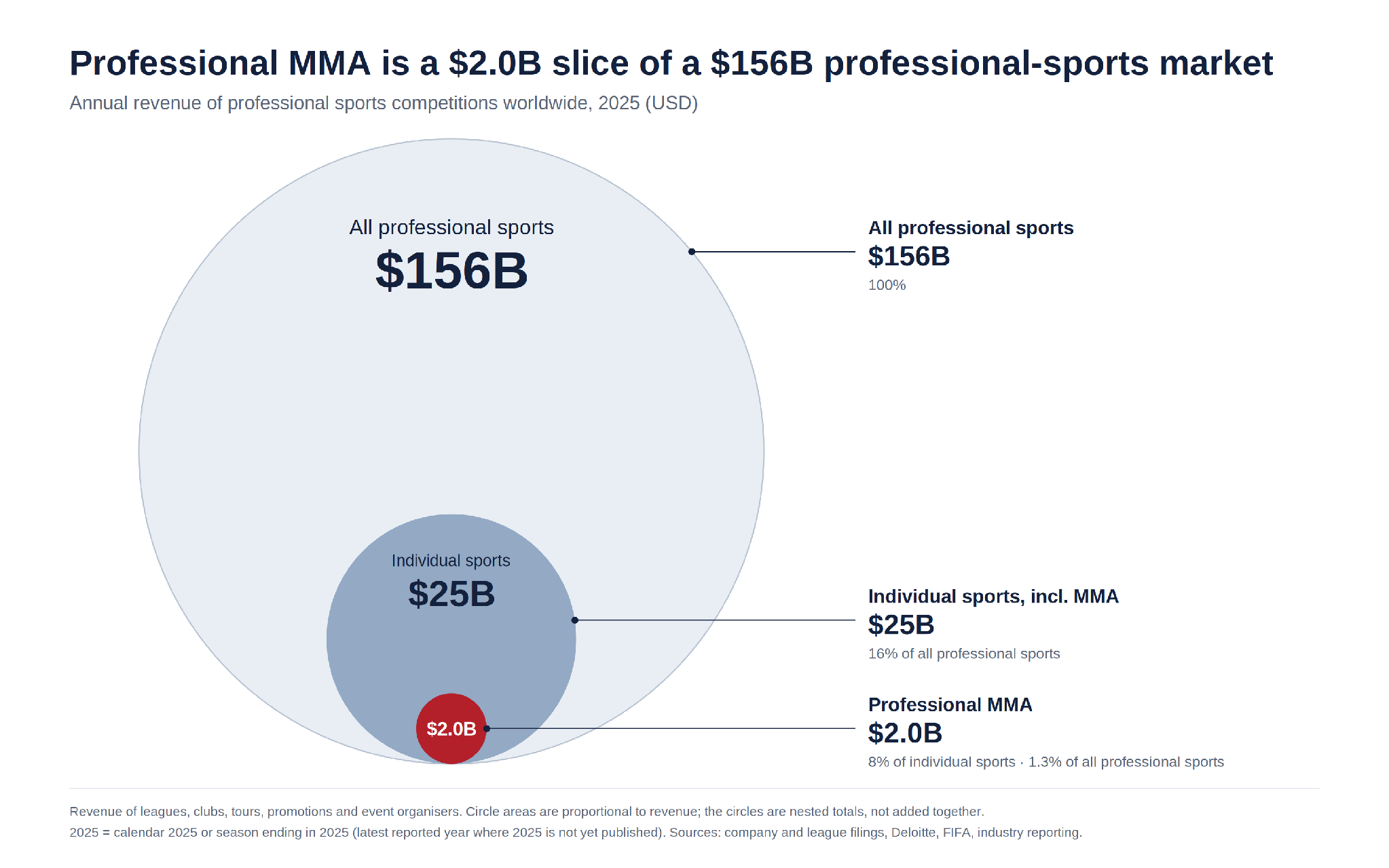
Exhibit 5: annual revenue of professional sports competitions worldwide in 2025.
LIV: the cautionary tale this model answers
Anyone investing in sports today has LIV Golf in mind. Saudi-backed money paid enormous sums to sign established stars, split the sport, and struggled to turn those names into a large audience. It is the textbook case of buying names without building attention.
First Light is the opposite on every axis. It enters early and cheap instead of late and expensive. It builds attention instead of renting it. And it's simply not a sport league; it works alongside the sport's largest stage rather than against it.
LIV also confirms the shape of the opportunity. An incentive shock, like the UFC's Paramount deal or LIV's arrival in golf, reshuffles who captures athlete value. Those shocks are when athletes are most open to a new kind of partner.
Team sports: the largest market, not the next one
Football, basketball and American football are the biggest sports by revenue and audience. Their stars are among the most valuable names in the world. But club and league structures, collective bargaining and group licensing of image rights make them harder to enter. Their size makes them the long-term prize, not the next step. Conquering individual sports first is the disciplined path.
The endgame: a media house
The lever is context, and context is media. The logical end of the model is to own the media layer outright: the formats, the production, the distribution and the library of stories built around the athletes First Light represents.
The closest precedent is Red Bull Media House, which turned a drink company's athlete sponsorships into a media business producing films, series, events and magazines. WWE runs a media company with athletes as its characters. LeBron James's SpringHill Company and Uninterrupted, and Derek Jeter's The Players' Tribune, showed athletes could own their own media. None of them combines owning stakes in the athletes with owning the media that builds them. That self-reinforcing combination is the end state.
What would prove this wrong
Four risks could break the model. Six more could slow it. Each is stated with what First Light does about it.
1. The promotion's power over the athlete
The UFC controls the cage, the rankings, the matchmaking and the contracts. Its promotional agreements claim broad rights over fighters' names and likenesses. It can stop booking a fighter, or treat a third party with a stake in a fighter as a threat to the rule that no fighter is bigger than the promotion. First Light's answer is to build fighters inside the platform, not pull them out of it, and to align incentives with the broadcaster, whose return grows with fighter fame. The exact contractual limits need legal review before the first deal.
2. The star leaves once they are a star
The more successful an athlete becomes, the more leverage they have to renegotiate or walk away. Star-making industries have faced this before. Hollywood's studio system weakened after the 1944 De Havilland ruling limited how long studios could bind actors. K-pop agencies have had repeated public contract disputes, most recently NewJeans against HYBE's label ADOR. Owning part of a person's name also invites the charge of exploitation those agencies face. First Light's answer is not stronger contracts. It is being the best partner an athlete could have, so that staying is the obvious choice, and pushing long-term alignment by giving athletes equity in First Light itself (Section 5). ABG's relationships with Shaquille O'Neal and David Beckham show what that looks like: stars who are glad to have a serious brand partner.
3. Key-person risk
It comes in two different forms.
- In-sport risk: injury, a losing streak, an early retirement. These hurt the athlete's sporting value and visibility. Building value outside the sport partly decouples the name from results, and a portfolio spreads the risk across athletes.
- Out-of-sport risk: a scandal or public misconduct. This damages the brand as a whole, and no portfolio of performance outcomes hedges it. The answer is strict selection on character, contractual protections, and partners who understand reputational risk.
4. Goodhart's law on the index
Today the Observatory cannot fully distinguish followers who came from real-world fame and followers acquired by gaming algorithms. For now, few athletes game online growth, so the signal is mostly clean. But once the index becomes a true valuation engine, there is an incentive to manipulate what it measures. The answer is to move the index toward measures that are hard to fake: engagement quality, audience composition, and conversion into tickets, products and subscriptions, or to separate the rating unit altogether.
Other risks
- The conflict of interest. First Light both rates athletes publicly and invests in them. A rater that is also an investor faces the conflict credit rating agencies faced. The answer is transparent methodology, published predictions that can be checked, and a clear separation between the published index and investment decisions.
- The lever may not industrialize. If every star is bespoke, First Light stays a boutique. Agentic tooling and repeatable formats are the answer to scale, but the economics have to be proven across several athletes.
- Enforceability. Rights of publicity differ by country and by state. Owning a share of a person's name is legally delicate, and the structure has to hold in every jurisdiction where an athlete earns.
- Liquidity. There is no secondary market yet for name assets, and the exit horizon is long. Exits depend on brand sales and strategic buyers. Cash from brand licensing, brand asset exits, media products, and production carries the business until then (Section 5).
- Adverse selection. The most obvious future stars have the most alternatives, and the most eager athletes may be the least likely to succeed. The answer is to position ourselves far from traditional managers, and provide unique services that compare to no alternatives. The key is to reach athletes before their rise is obvious, and offer a partnership the best athletes can't do without (Section 5).